
The Cosmic Hand: Exploring MSH 15–52
The Hand-Shaped Pulsar Wind Nebula
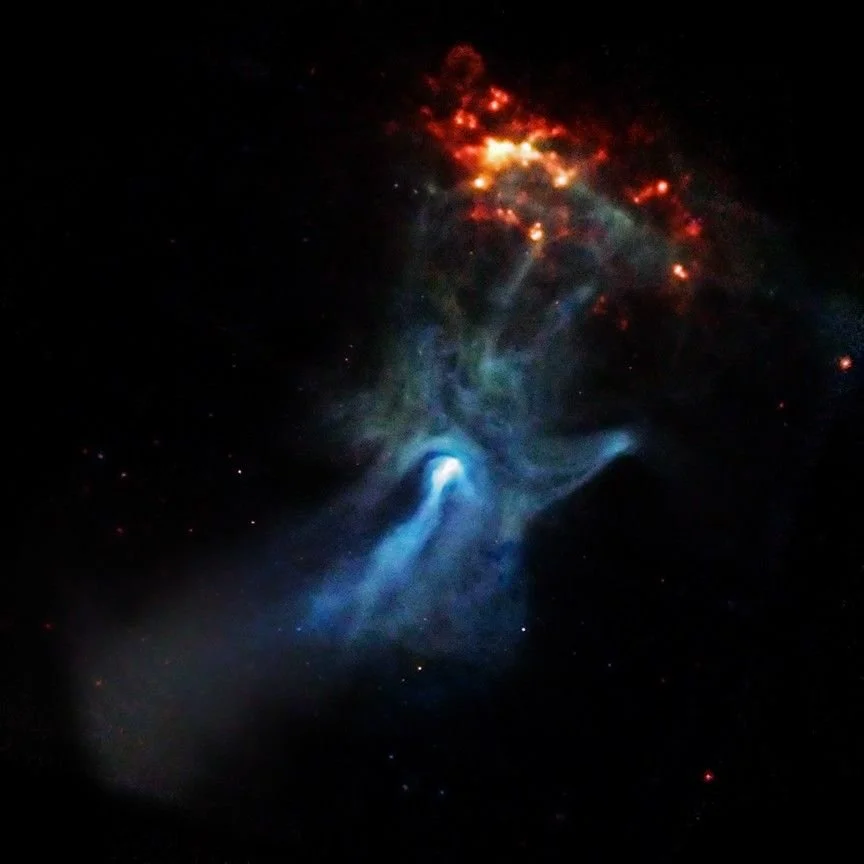
In the vast expanse of our Milky Way, about 17,000 light-years away in the constellation Circinus, lies one of the most striking and energetic remnants of a stellar explosion: MSH 15–52 (also known as G320.4–1.2). This pulsar wind nebula (PWN), powered by the ultra-energetic pulsar PSR B1509–58, has captivated astronomers for decades with its uncanny resemblance to a human hand reaching out into space. Nicknamed the "Cosmic Hand" or "Hand of God," it is a dramatic example of how a tiny, spinning neutron star can sculpt vast clouds of relativistic particles over thousands of years.
Credit: NASA/CXC/SAO/P.Slane, Et Al. 2009
The Birth of a Monster: A Massive Star's Explosive Death
PSR B1509–58 formed from the core collapse of a massive star whose initial mass is estimated to have been between 8 and 15 solar masses (after accounting for mass loss during its lifetime). The explosion left behind a neutron star only ~12 miles across but containing roughly 1.4 solar masses. PSR B1509–58 spins nearly 7 times per second (period ~150 ms) and possesses one of the highest known rates of loss of rotational energy, known as spin-down luminosity (Ė ≈ 1.8 × 1037 erg s⁻¹), making it an extreme example of a very young and energetic pulsar. The pulsar possesses an intense magnetic field (10¹²–10¹³ G at the surface) that channels a relativistic wind of electrons-positrons pairs, inflating the surrounding pulsar wind nebula MSH 15–52, which spans more than 150 light-years[1].
Why Does It Look Like a Hand?
Astronomers think the hand shape happened because the baby neutron star got kicked hard (~several hundred km s⁻¹) in one direction when it was born (like a rocket recoiling). That kick pushed the whole bubble sideways, squashing one side and stretching the other into fingers. Chandra images reveal a bright "palm" centered on the pulsar, a compact equatorial torus, and possible polar jets nearby. The elongated "fingers" are extended outflows that flow northward toward the bright shell RCW 89, illuminating bright knots and filaments at the "fingertips."
The entire structure results from the intricate processes involved in the interaction between the PWN from the north and the supernova's reverse shock, crushing it and driving relativistic charged particles northward to form the elongated hand morphology [2][3].
Metal-Rich Ejecta in the Fingers
A long-standing question was whether the material in the fingers and RCW 89 is merely pre-existing interstellar medium energized by the PWN, or actual supernova ejecta. Deep Chandra spectroscopy of compact knots in the fingertips reveals strong overabundances of neon (Ne ≈ 5–10 × solar), magnesium (Mg ≈ 3–10 × solar), and silicon—clear signatures of oxygen/neon-burning products from the progenitor star [4]. These knots exhibit thermal spectra (kT ≈ 0.5–1 keV) and proper motions of several thousand km s⁻¹, far exceeding typical velocities of the surrounding gas but matching expectations for SN ejecta. Coincident optical Hα filaments display characteristics seen in bright shocks, typical of metal-enriched debris seen in other remnants of SN, like the Cassiopeia A knots.
These observations firmly link the northern part of RCW 89 to the same supernova that produced PSR B1509–58: it is the shocked ejecta interface, not unrelated ambient material.
New Views in 2025: Radio and X-ray Go Hand in Hand
In August 2025, NASA released a stunning composite combining decades of the Chandra X-Ray Space Telescope data with new high-resolution radio observations from the Australia Telescope Compact Array (ATCA)[5].
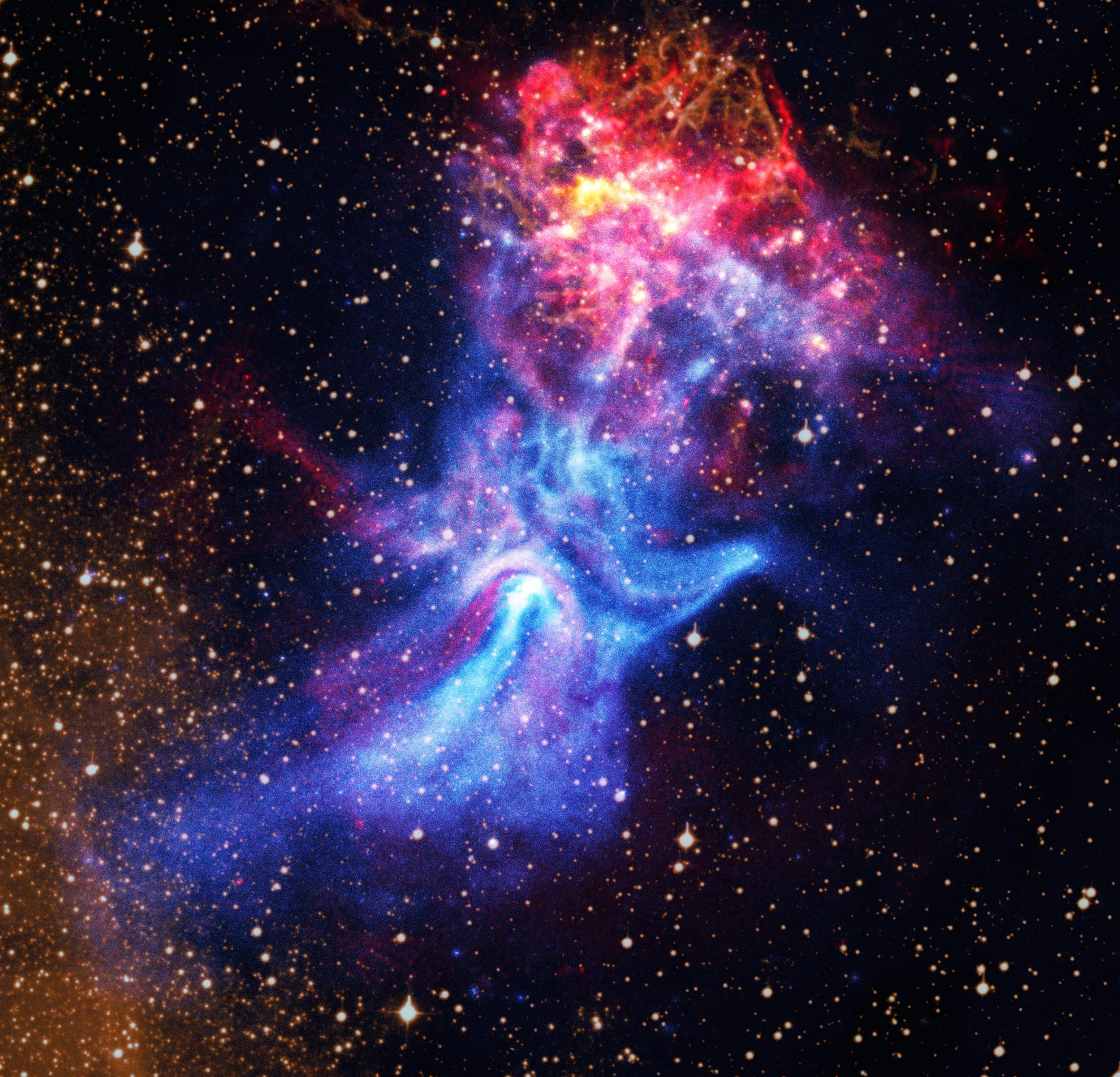
X-rays (blue/orange/yellow): trace the hottest synchrotron-emitting relativistic particles. Radio (red): highlight cooler synchrotron emission and magnetic field-aligned structures. Optical Hα (gold): reveals shocked hydrogen in RCW 89. Credit: X-ray: NASA/CXC/Univ. of Hong Kong/S. Zhang et al.; Radio: ATNF/CSIRO/ATCA; H-alpha: UK STFC/Royal Observatory Edinburgh
The new ATCA maps reach ~2″ resolution—the sharpest radio images yet—revealing fine filaments, knots, and apparent distortion of RCW 89's shell by the PWN outflow [4]. Where X-ray and radio overlap, the image turns purple. Notably, some bright X-ray features (e.g., the southern jet and inner finger regions) largely disappear in radio, indicating particle leaking from the termination shock — where the fast-moving pulsar wind abruptly slows down and is compressed by the surrounding medium. These escaping streams suppress radio emission through a process known as synchrotron cooling, in which high-energy electrons lose energy rapidly, making them too cool to be detected.
Remaining puzzles include patchy radio emission extending beyond the X-ray boundary (suggesting interaction with a dense cloud) and a sharp northeastern X-ray blast wave with no clear radio counterpart—an unusual trait for young SN remnants.
A Controversial Twist: Are MSH 15–52 and RCW 89 Really One System?
The mainstream view treats the entire complex as a single, highly asymmetric composite remnant. However, a September 2025 paper by Noam Soker argues that RCW 89 is an older, unrelated supernova remnant shaped by the jittering-jets explosion mechanism (JJEM), with MSH 15–52 simply overlapping and interacting with it by chance [6]. Soker highlights point-symmetric features in the new radio maps centered within RCW 89 (not at the pulsar). This interpretation, however, does not address the X-ray spectroscopic evidence for enriched ejecta in the interaction zone, and the broader community continues to favor the single-remnant, reverse-shock-crushing model.
Why MSH 15–52 Matters
This system remains a premier laboratory for studying particle acceleration to PeV energies, pulsar natal kicks, reverse-shock/PWN interactions, and asymmetric evolution of composite supernova remnants. More energetic and morphologically complex than the Crab Nebula, yet sharing fundamental physics, the Cosmic Hand continues to challenge and refine our understanding of the Galaxy's most extreme rotators.
With 2025's exquisite new radio data and ongoing debate, the Cosmic Hand keeps reaching out—reminding us how much mystery still lingers in the aftermath of stellar death.
References:
[1] https://science.nasa.gov/resource/pulsar-psr-b1509-58-shows-its-hand/'
[2] Bryan M. Gaensler, Patrick O. Slane 2006, ARAA, 44, 17
[3] Hongjun An, Kristin K. Madsen, Stephen P. Reynolds, Victoria M. Kaspi, Fiona A. Harrison, Steven E. Boggs, Finn E. Christensen, William W. Craig, Chris L. Fryer, Brian W. Grefenstette, Charles J. Hailey, Kaya Mori, Daniel Stern, and William W. Zhang 2014 ApJ 793 90: https://iopscience.iop.org/article/10.1088/0004-637X/793/2/90#apj500056f3
[4] “Borkowski, J.B., Stephen P. Reynolds, S.P., and William Miltich, W. 2020, ApJL, 2, L32
This material may be protected by copyright.
[5] https://iopscience.iop.org/article/10.3847/1538-4357/adf333 Zhang
[6] Soaker Noam 2025, PASP, 237, 11