
Hubble Egg Nebula: A Glimpse into Stellar Evolution
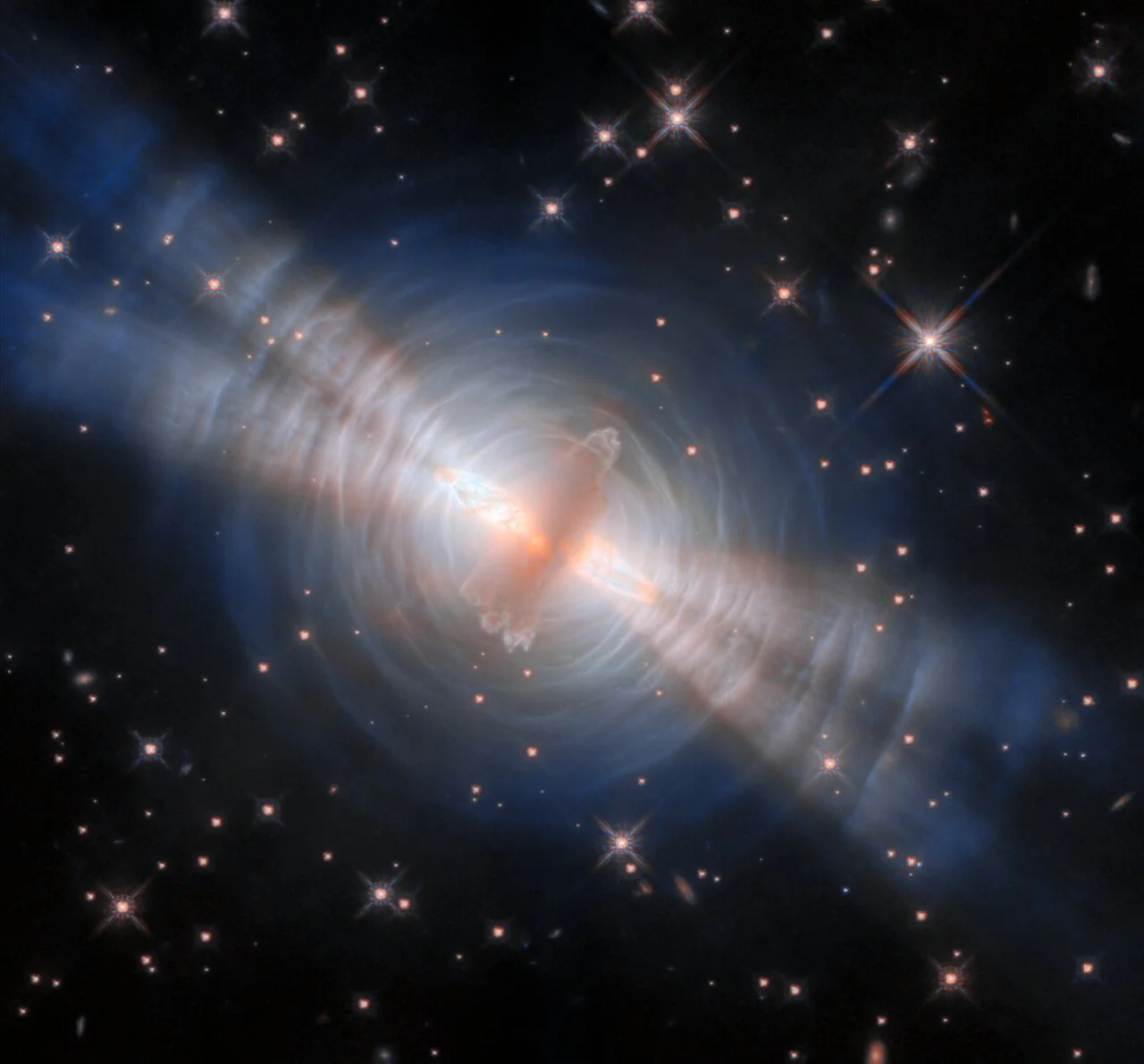
The NASA/ESA Hubble Space Telescope has once again delivered a breathtaking image of the Egg Nebula (also known as CRL 2688), a pre-planetary nebula that showcases
Located in the constellation Cygnus, this object lies approximately 1,000 light-years from Earth and spans about 1 light-year across. What makes the Egg Nebula particularly fascinating is its clear dust disk and a pair of powerful beams shooting out perpendicular to it, hinting at the presence of two interacting stars at its core.
What is in the image?
In this vivid Hubble capture, we observe the typical bidirectional jets emanating from a central dust disk. The thick dust obscures the central stars, but their presence is revealed through reflected light in the concentric shells and the illuminated jets. These shells resemble onion-like layers, formed as one of the central stars—likely in its late asymptotic giant branch (AGB) phase—periodically expels carbon-enriched material every few hundred years. As this material drifts away, it cools and forms dust, which is then illuminated by the star's light. Hubble's observations primarily capture the blue and white reflected light, giving the structure its ethereal, rippled appearance.
The outer shells may have been ejected around 1,000 years ago, expanding at speeds of about 18 km/s, with more recent thermal pulses occurring every 50-100 years. Closer to the center, the shells become densely packed until they encounter the thick central dust disk, which is pierced by high-speed jets on both sides. This disk, only a few hundred years old, is thought to arise from a binary star system in a "common envelope" phase. Here, a smaller companion star orbits closely enough to gravitationally strip material from the larger, dying star's atmosphere. Over time, this accreted material becomes unstable, leading to rapid expulsions that form a toroidal (doughnut-shaped) structure. This channels the AGB wind along the poles, creating the observed funnels of gas.
The magnetic fields around the stars likely accelerate this gas to speeds of 50-100 km/s—far faster than typical stellar winds. As the gas is illuminated by the central star's radiation, it emits the blue and white glow captured by Hubble. Fast-moving outflows of hot molecular hydrogen appear as orange highlights in infrared views.
Understanding Pre-Planetary Nebulae and Planetary Nebulae
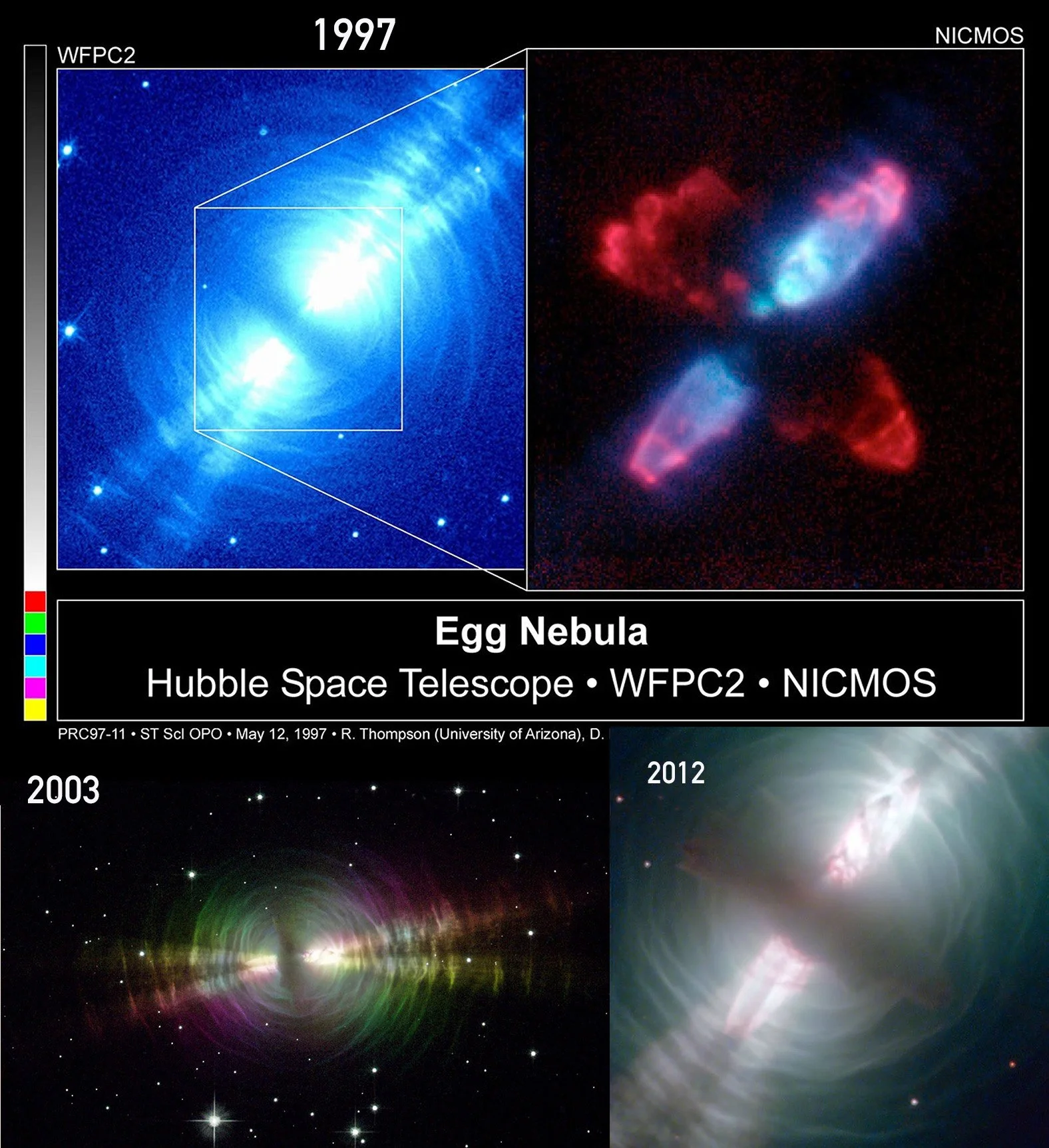
Over the years, Hubble has provided multiple perspectives on the Egg Nebula, combining data from observations in 1997, 2003, 2012, and beyond to reveal its dynamic structure and evolution. These images allow astronomers to track changes over decades, refining models of how such objects form and evolve.
The Egg Nebula is in a fleeting pre-planetary nebula phase, a short transitional period lasting just a few thousand years between the late AGB stage and a full planetary nebula. During this time, a Sun-like star (with 1-8 solar masses) sheds its outer layers as it exhausts its nuclear fuel, but the exposed core isn't yet hot enough to fully ionize the surrounding gas. The material is illuminated by reflected starlight rather than glowing from ionization, making these objects dim and rare—only a handful exist at any given time. The Egg Nebula is the youngest, closest, and first discovered example, offering a unique window into this process.
In contrast, planetary nebulae form when the core heats up sufficiently (to tens of thousands of degrees) to ionize the ejected gas, causing it to glow brightly in colors determined by elements like oxygen (green/blue) and nitrogen (red). These expanding shells last about 20,000 years and have nothing to do with planets—the name stems from their round, planet-like appearance in early telescopes. They represent the star's final act, dispersing material that seeds future stars and planets, including heavy elements forged in the star's core.
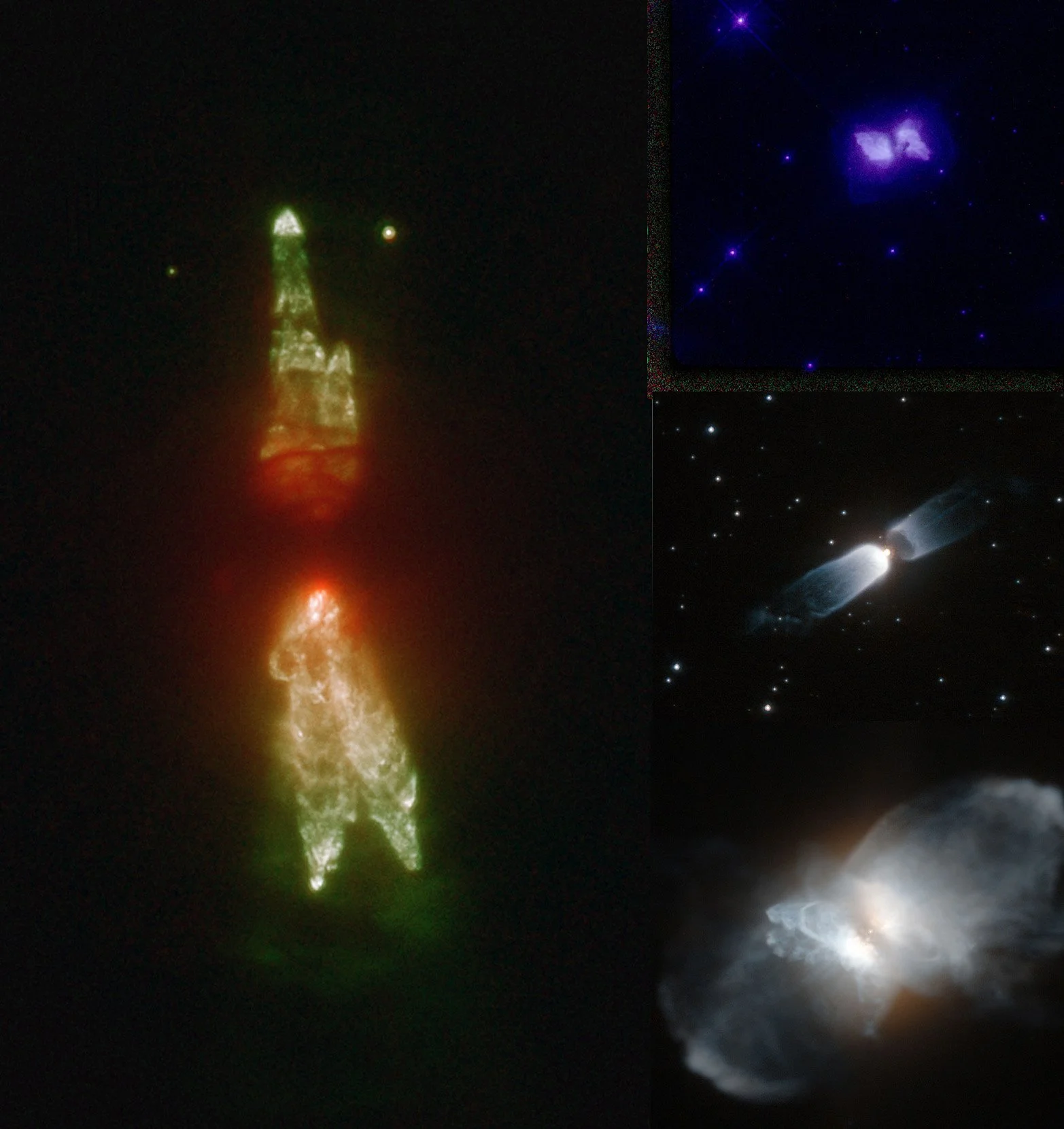
Objects like the Egg Nebula are not unique, but their brevity makes them special. Other pre-planetary nebulae observed by Hubble include the Westbrook Nebula, IRAS 13208-6020, Roberts 22, and the Frosty Leo Nebula. Planetary nebulae with similar bipolar shapes and jets—often shaped by binary interactions—include the Butterfly Nebula (NGC 6302), the Cat's Eye Nebula (NGC 6543), and the Helix Nebula (NGC 7293). These intricate forms reveal how binary stars accelerate stellar death and create the diverse shapes we observe.
Hubble's ability to peer into these details not only highlights the beauty of cosmic endings but also sheds light on the past, present, and future of stellar evolution—including what awaits our own Sun in about 5 billion years. As we continue to study these "stellar ghosts," we gain deeper insights into the universe's recycling process, where dying stars enrich the cosmos for new generations.